Birmingham City Centre Property Market Update: What Landl...
Birmingham city centre’s residential market has moved into a more selective phase during the first half of 2026. Demand for well-located ...


Despite the external factors impacting the housing market, UK property remains an incredibly popular investment asset that delivers exceptional returns. According to data from Market Financial Solutions, 16% of UK adults have a domestic property investment – around one in six people – and are leveraging the asset to deliver an ongoing income or prepare for retirement.
Despite current buy-to-let mortgage rates impacting profits, a huge 54% of investors are also positive about the market and believe interest rates will fall as the economy improves.
So, with sentiment more bullish than ever, where should investors look to take advantage?
While many UK cities offer different levels of return, today we’re focusing on Birmingham. The second city has been a market leader for nearly a decade, delivering above-average rental returns whilst experiencing some of the best capital growth in the country since 2016.
But what is the outlook for Birmingham today? As we enter the new year and investors look to re-evaluate their property portfolio, is Birmingham the best UK city to invest in?
Since 2007, Birmingham’s future has been dictated by the ‘Big City Plan’, a 20-year masterplan that has completely revitalised the local infrastructure and transformed the skyline.
The redevelopment of New Street Station, Library of Birmingham, Arena, Paradise, Midland Metro and City Park all fell under the initial stages of this plan, creating exciting new amenities, commercial areas and office space for Birmingham residents.
Now, we’re entering the next stages of the wider plan, set to take things one step further. The headline scheme is Birmingham Smithfield – a £1.9 billion project around the Digbeth and Smithfield area of the city that will deliver new homes, offices and public spaces for Birmingham residents.
This will be followed up by schemes such as HS2’s completion, the £100 million Ironworks project, the development of the former Axis Square and the ‘JQ Transformation’, which is expected to revitalise certain sections of the desirable neighbourhood.
All of these projects are combining to create an incredible range of new amenities alongside commercial, office and residential spaces.
Birmingham supply is still failing to hit targets, and for investors, any new residential investment opportunity represents the chance to take advantage of a thriving rental market on top of ever-increasing demand for accommodation.
According to Birmingham City Council, the current requirement for new homes each year is around 4,440 – translating to 27,000 over the next five years when accounting for uplift.
The same report suggests that around 18,000 dwellings are currently under construction, highlighting the need for more residential space.
While more properties are in planning, many of these projects are still several years away, and as more amenity-led schemes complete, it’s fair to assume that housing requirements may increase.
Supply and demand is the lifeblood of a property investment, so it’s easy to see why Birmingham remains a key UK city for investors seeking consistent demand.
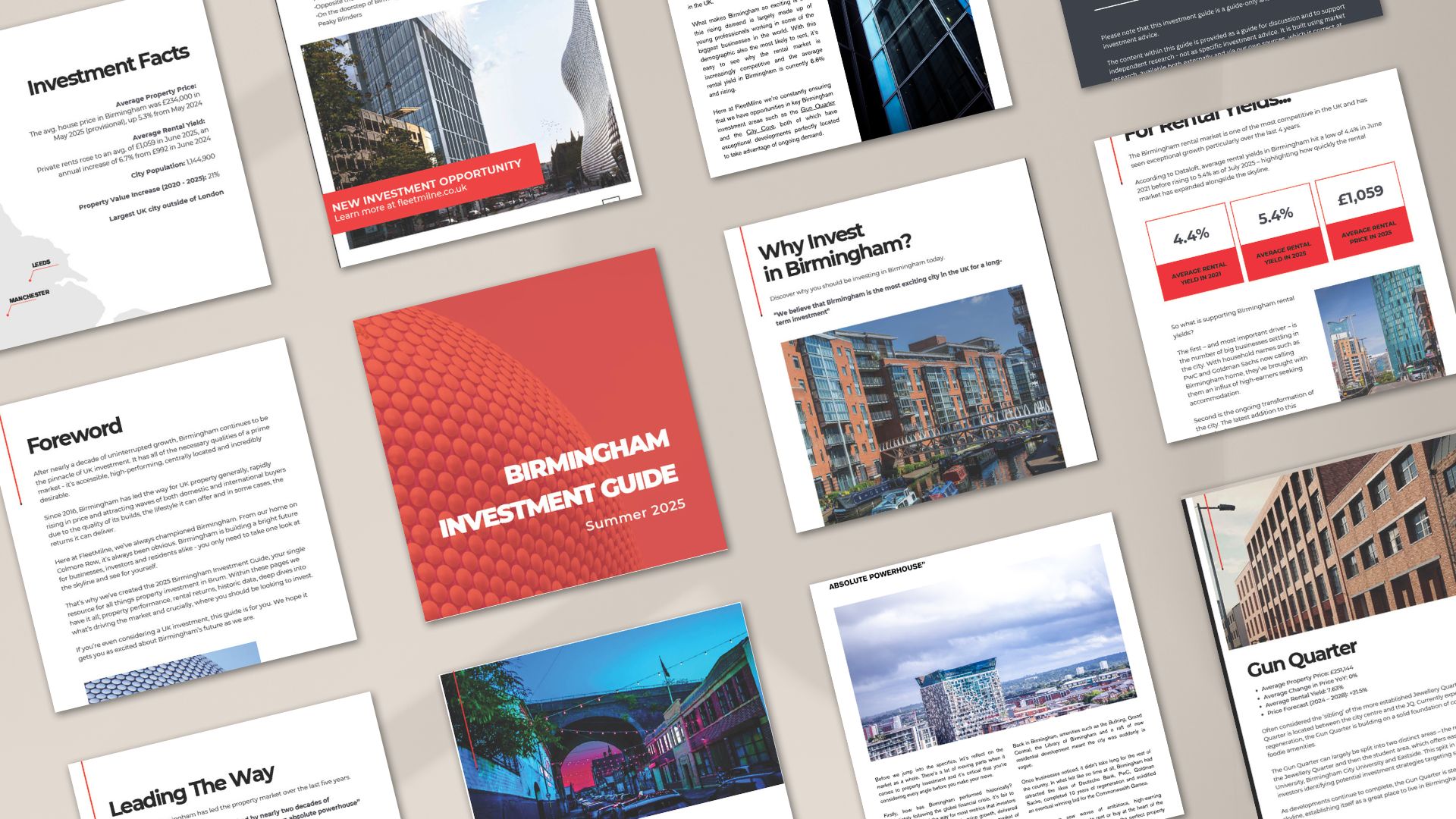
Download Our Free Birmingham Investment Guide Today!
Birmingham’s current rental performance is exceptional, built on the momentum of the ‘race for space’ between 2020 and 2023. While many UK cities have seen rental returns decrease over time, Birmingham rents have only continued to increase, a huge positive for investors seeking a consistent return on investment.
As we highlighted in our piece Why Invest in Birmingham, Birmingham’s average rental yield is now 5.4%, a huge increase from the 4.4% average it was in June 2021.
According to property data for the area, the average rent for a one-bedroom apartment increased by 8.4%, while the average rent for a two-bedroom apartment increased by 6.7% – reinforcing the excellent growth that these popular property types are experiencing.
So what does the future hold for Birmingham rents? As we highlighted in our Birmingham property market update, over the next four years, Savills suggest that rental prices will rise by 4% in 2025 with a cumulative growth of 17.6% by 2029.
While Birmingham has always been a popular destination for domestic investors, Birmingham has historically lost out to cities such as London on the international stage as they’re more well-known.
Now, however, after transforming its skyline, attracting household employers such as Goldman Sachs and winning bids for global events such as the Commonwealth Games, Birmingham is a much more recognisable name for foreign investment.
While this makes the market more competitive, it’s a significant indicator of the strength of the market and the ongoing positive sentiment around its investment future.
Birmingham’s final investment strength is the diverse range of property it’s able to provide investors, helping support a wide variety of investment strategies.
Whether you’re investing in city-centre apartments, larger houses in suburban neighbourhoods, student developments or HMOs, Birmingham property can support.
The city itself also has several different neighbourhoods that offer various benefits and drawbacks. Digbeth, for example, serves a much younger demographic and is home to high-yielding properties, making it ideal for investors targeting a student or graduate demographic.
The Jewellery Quarter, on the other hand, is full of both new and renovated properties that are ideally positioned for high-powered professional couples who are seeking a slower pace of life just outside of the city core.
If you want to know more about Birmingham property investment or have an idea of where you’d like to invest, you can browse our current investment opportunities here.

Birmingham city centre’s residential market has moved into a more selective phase during the first half of 2026. Demand for well-located ...

When FleetMilne became sponsors of the Birmingham Business Best Places to Work Awards 2026, one thing quickly became clear: our Managing ...

It’s a question many buyers are asking again: Is now a good time to buy property? After a period dominated by rising interest


